
Payment solutions beyond universities
Explore how education payment solutions support VET colleges, ELICOS providers and schools in Australia. Understand ESOS fee requirements, payment processes and how international students and families can pay tuition and other education-related fees.

Payment solutions beyond universities: VET, ELICOS and schools
Key takeaways
• Education payment solutions need to reflect howvocational education and training (VET) providers, English language collegesand schools operate, rather than assume every institution collects fees like auniversity.
• VET, ELICOS and school providers operate under theEducation Services for Overseas Students (ESOS) framework, although regulatoryoversight differs by sector.
• The 50% upfront tuition limit applies to courses longerthan 25 weeks. Shorter ELICOS courses can therefore be paid in full beforecommencement.
• For international school students under 18, a parent orguardian must accept the written agreement. Any non-tuition charges, includingaccommodation where relevant, must be disclosed.
• Payment links, familiar international payment methods andreliable student references can reduce the work involved in reconciling fees.
Australia’s internationaleducation sector extends well beyond universities. Vocational colleges, Englishlanguage providers and schools welcome students from overseas, yet the way theyinvoice and collect fees can differ substantially. Course structures vary,parents may pay on a student’s behalf, and smaller finance teams often managepayments alongside other responsibilities. For these institutions, the righteducation payment solutions need to reflect how enrolment and fee collectionactually work.
What do education payment solutions need to do beyond universities?
Education payment solutions forVET, ELICOS and school providers need to accommodate different course lengths,payment schedules and people making the payment. They also need to help financeteams identify incoming funds without spending hours matching transactions tostudent records.
The underlying task isstraightforward: collect the fee, identify the student and keep enrolmentmoving. The complexity lies in how each institution structures its courses andcharges:
• VET providers may collect instalments across differentunits or study periods.
• English Language Intensive Courses for Overseas Students(ELICOS) may run for a shorter period or form the first stage of a longer studypathway.
• Schools often deal directly with parents or guardians andmay collect accommodation and welfare charges in addition to tuition.
Which rules apply across VET, ELICOS and schools?
Australian education providersenrolling international students on student visas must be registered on theCommonwealth Register of Institutions and Courses for Overseas Students(CRICOS). All operate within the ESOS framework, but responsibility for oversightvaries by sector.
According to the Department of Education's listof ESOS agencies:
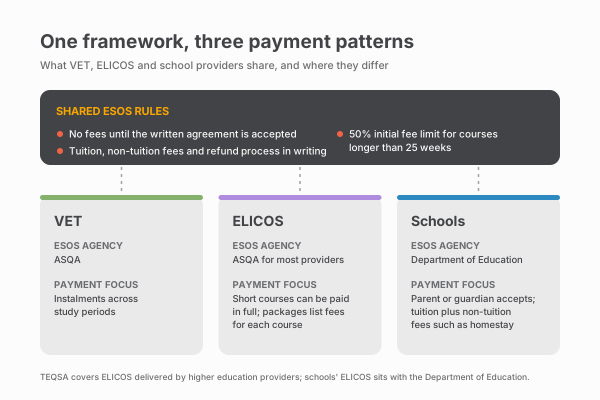
• The Australian Skills Quality Authority (ASQA) overseesregistered training organisations and most ELICOS providers.
• The Tertiary Education Quality and Standards Agency(TEQSA) oversees ELICOS delivered by higher education providers or underrelevant entry arrangements.
• The Secretary of the Department of Education is the ESOSagency for schools, including ELICOS delivered by schools.
The payment rules are shared, and they set the CRICOSprovider payment requirements for every sector. Under Standard 3 of the National Code, a provider can't accept fees until the writtenagreement is accepted. That agreement must list tuition and non-tuition feesand the refund process. Since amendments in 2015, a provider can't collect morethan 50% of the total tuition fee upfront for a course longer than 25 weeks.The exception is when the payer chooses to pay more.
How do payments work for VET providers?
For VET colleges, fee collectionoften follows the structure of the qualification. A student may pay acrossseveral study periods rather than in one transaction. Vocational collegepayment solutions therefore need to make instalments easy to identify, witheach payment recorded against the correct student and period of study.
For courses longer than 25weeks, the 50% initial tuition fee limit also affects when payments can becollected. Subsequent instalments need to reflect the schedule set out in thewritten agreement.
In practice, that meansproviders need:
• invoices that clearly identify the instalment and student
• payment options suited to students both overseas and inAustralia
• a straightforward way to distinguish paid, partially paidand overdue balances
Consider a registered trainingorganisation with several intakes throughout the year. Each intake brings itsown instalment dates. When payments arrive without a reliable studentreference, the finance team has to investigate before updating the student’saccount. A payment link carrying that reference can make the process easier tomanage.
What's different about ELICOS fee payments?
ELICOS courses are intensive English courses, defined as atleast 20 scheduled hours of face-to-face English classes a week under the ELICOS Standards 2018. Some are short, which changes how fees can be collected.
Course length matters. An ELICOSprogramme lasting 25 weeks or less can be paid in full before it begins, whilethe 50% initial tuition fee limit applies to courses longer than 25 weeks.
An English language course mayalso be part of a package leading to further study. Where a written agreementcovers multiple courses, Standard 3 requires tuition and non-tuition fees to beitemised for each. ELICOS provider payment solutions, including paymentsolutions for language schools, should help institutions distinguish paymentsmade towards one course from those made towards another.
How do international school fee payments work?
For younger international schoolstudents, fee collection involves an additional party. Under Standard 3, aparent or guardian must accept the written agreement for a student under 18before the school can collect fees.
Tuition is not necessarily theonly charge. Where a school approves a younger student’s accommodation andwelfare arrangements, it confirms these through a Confirmation of AppropriateAccommodation and Welfare (CAAW) under Standard 5 of the National Code. Relatednon-tuition charges, including homestay fees where applicable, must appear inthe written agreement.
For families paying fromoverseas, practical school fee payment solutions should provide:
• payment methods familiar to parents in their home country
• a clear distinction between tuition and other charges
• records identifying the payer, particularly when a refundis required
How do the three sectors compare?
The regulatory framework isshared, but the way money moves through each institution is not. The comparisonbelow brings together the main differences.
The related post on what to look for in an international student payment partner covers the selection questions in more detail.
What to do now
• Identify the fees your institution collects and separatetuition from non-tuition charges.
• Review initial invoices for courses longer than 25 weeksagainst the 50% limit.
• Check that agreements covering multiple courses itemisethe fees for each course.
• Confirm the required parent or guardian acceptance beforecollecting fees for students under 18.
• Use a consistent student reference across paymentchannels, including bank transfers.
• Assess whether overseas families can pay using methodsfamiliar to them.
• Keep a record of the person who made each payment tosupport refund processing.
Frequently asked questions
Do ESOS payment rules applyto VET, ELICOS and schools?
Yes. CRICOS-registered providersacross all three sectors must comply with the ESOS framework, including theNational Code requirements for written agreements, fees and refunds.
Can an ELICOS course be paidin full upfront?
Yes. The 50% initial tuition feelimit applies to courses longer than 25 weeks, not to courses of 25 weeks orless.
Who pays fees forinternational school students?
For students under 18, a parentor guardian accepts the written agreement. The person making the payment may besomeone else, which makes accurate payer records important.
Who regulates ELICOSproviders?
ASQA oversees most ELICOSproviders. TEQSA covers relevant higher education arrangements, while theDepartment of Education oversees ELICOS delivered by schools.
Can international studentspay with Alipay or WeChat Pay?
They can, provided theinstitution offers these options. Online payment pages and payment links cansupport digital wallets familiar to students and families in Asia.
How Novatti helps
We help education providers accept Alipay, WeChat Pay andUnionPay, with settlement within 2 business days. With PayByLink, you can send families and students a secure payment link for each invoice. See how we support education providers.
Talk to our education payments team about what would suit your institution.
Information correct as at 20 October 2026.
The information on this website is general in nature and should not be considered financial advice, it does not take into account your personal circumstances or needs, please consider our Product Disclosure Statements and TMDs for each product and if the information is right for you before acquiring the product or service.
Blog
Related blog articles

Acquirer vs issuer: what's the difference?
International student payments shape the student experience. See how payment choice, visibility and reconciliation can reduce friction for universities.
International student payments are part of the student experience
International student payments shape the student experience. See how payment choice, visibility and reconciliation can reduce friction for universities.

Student payment reconciliation: How universities can reduce manual finance admin
Universities are expanding the ways students can pay, but more payment options can also create more work for finance teams. Automated student payment reconciliation can reduce manual admin, improve visibility and create a smoother experience for both students and universities.